
Research updates from Luvaminos
Subscribe for catalog updates, new research compounds, and quality documentation releases.
For researchers and labs. No spam — unsubscribe anytime.
Research updates from Luvaminos
Subscribe for catalog updates, new research compounds, and quality documentation releases.
For researchers and labs. No spam — unsubscribe anytime.
Cellular
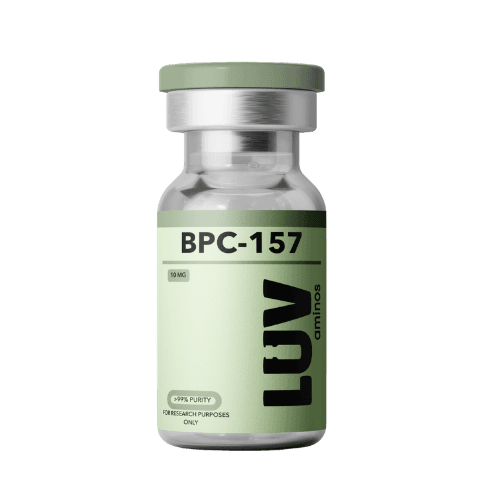
A synthetic peptide investigated in vitro and in preclinical cellular research.
Reviewed by Dr. James Whitfield, PharmD · Published · Last reviewed · For research use only.
Type
Synthetic peptide (pentadecapeptide)
Molecular formula
C62H98N16O22
Molecular weight
1,419.5 g/mol
CAS number
137525-51-0
Amino acids
15
Sequence
GEPPPGKPADDAGLV
Modification
Free N- and C-termini; commonly supplied as an acetate or TFA salt.
A partial sequence derived from a human gastric-juice protein. Research literature characterizes it in relation to the VEGFR2 and nitric-oxide (eNOS) signaling pathways; it is not assigned a single cell-surface receptor.
Lyophilized
20°C
~24 months desiccated and protected from light.
Protect from light and moisture; aliquot to avoid freeze-thaw.
Reviews
Vasireddi N, et al. (2025). HSS Journal
Whitehouse M. (2025). Inflammopharmacology
Sikiric P, et al. (2024). Inflammopharmacology
Reviews
Sikiric P, et al. (2024). Pharmaceuticals
Sikiric P, et al. (2022). World J Gastroenterol
Vukojevic J, et al. (2022). Neural Regeneration Research
Seiwerth S, et al. (2021). Front Pharmacol
Sikiric P, et al. (2020). Gut and Liver
Gwyer D, et al. (2019). Cell Tissue Res
Sikiric P, et al. (2016). Curr Neuropharmacol
Sikiric P, et al. (2011). Curr Pharm Des
Clinical
Lee E, Burgess K. (2025). Altern Ther Health Med
Lee E, et al. (2024). Altern Ther Health Med
Lee E, Padgett B. (2021). Altern Ther Health Med
ClinicalTrials.gov. ClinicalTrials.gov
ClinicalTrials.gov. ClinicalTrials.gov
Primary research
He L, et al. (2022). Front Pharmacol
Sikiric P, et al. (2022). Biomedicines
Hsieh MJ, et al. (2020). Sci Rep
Perovic D, et al. (2019). J Orthop Surg Res
Wang XY, et al. (2019). Neuroscience Bulletin
Hsieh MJ, et al. (2017). J Mol Med (Berlin)
Duzel A, et al. (2017). World J Gastroenterol
Chang CH, et al. (2014). Molecules
Chang CH, et al. (2011). J Appl Physiol
Gjurasin M, et al. (2010). Regulatory Peptides
Cerovecki T, et al. (2010). J Orthop Res
Novinscak T, et al. (2008). Surgery Today
Tkalcevic VI, et al. (2007). Eur J Pharmacol
Krivic A, et al. (2006). J Orthop Res
Boban Blagaic A, et al. (2005). Eur J Pharmacol
Staresinic M, et al. (2003). J Orthop Res
Sebecic B, et al. (1999). Bone
Sikiric P, et al. (1993). Life Sciences
Sikiric P, et al. (1993). J Physiol (Paris)
Also known as: Body Protection Compound-157
Research Use Only
These products are intended for research purposes only and are not for human consumption. Not FDA approved. Not intended to diagnose, treat, cure, or prevent any disease.
| Compound | Type | Molecular weight | CAS number |
|---|---|---|---|
| BPC-157This page | Synthetic peptide (pentadecapeptide) | 1,419.5 g/mol | 137525-51-0 |
| TB-500 | Synthetic peptide (Thymosin Beta-4 related) | ~4,963 g/mol | 77591-33-4 |
| Epithalon | Synthetic linear tetrapeptide | 390.35 g/mol | 307297-39-8 |
| SS-31 | Synthetic aromatic-cationic tetrapeptide (C-terminally amidated, mitochondria-targeted) | 639.8 g/mol | 736992-21-5 |
| BPC-157 + TB-500 + GHK-Cu + KPV | Peptide blend | — | — |
Comparison of laboratory reference specifications only. For research use only; not a therapeutic comparison.
Quality & methods